
Why understanding words is just as important as knowing them
When you ask your child, “What happened at school today?” Have they ever said, “Nothing” or “I don’t know”? For many school-age kids, especially those who are neurodivergent, vocabulary and understanding can be harder than just “learning new words.”
A child may know a lot of words but still has trouble understanding directions, stories, conversations in class, or jokes with friends. Vocabulary and understanding are the building blocks of learning, making friends, and feeling good about yourself in school. Research consistently demonstrates that robust language comprehension not only forecasts reading success but also facilitates academic achievement across diverse subjects.
The good news is that you can improve your vocabulary and understanding by having meaningful conversations, being taught directly, and doing things every day.
In this article, we will look at how these skills grow, why some children find them difficult, and practical ways parents can encourage language development at home without making daily life feel like a lesson.
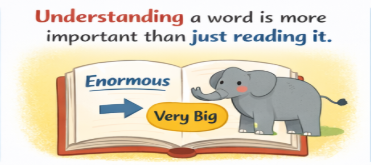
Vocabulary includes all the words a child knows and uses, while comprehension is how well they understand language, stories, and facts.
These two skills are related to each other. When you learn new words, you understand more. Children learn even more words when they understand things better. Studies on how children learn a language show that knowing a lot of words is closely linked to being able to read well, doing well in school, and being interested in class.
Children with a large vocabulary are more likely to: Follow directions that have more than one step, Understand what is being said in class, Talk to your friends, Learn new things from books and lessons, and Make their thoughts clear.
On the other hand, children who have trouble understanding might seem disinterested, confused, or unwilling to join in, even when they are trying hard. Therefore, fostering vocabulary growth early on can significantly enhance children’s school experiences.
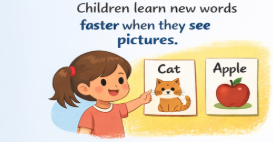
Every child learns a language at a different pace. Neurodivergent children may process language in ways that are different from other children, which can make some words and ideas harder to understand.
Typical issues include:
It’s difficult to put words to what has occurred to you. Additionally, a few fundamental abilities are crucial for comprehending language, including:
Children may require more direct and encouraging methods to acquire a language rather than just picking it up on their own when these abilities don’t function in the same manner.
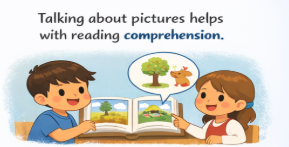
Research on language development and speech therapy identifies several effective methods to boost vocabulary growth. The focus is on meaningful understanding rather than rote memorization.
Children learn new words best when they can connect them to things that happen every day. Don’t just use worksheets to teach vocabulary; link it to things you do every day. For example, in the store: “These apples are crunchy.”
“Let’s look at the big watermelon and the small one.”
At home:
“We have to wait because the soup is hot.”
“This towel is wet.”
These natural moments help kids connect words to their senses and the situation, which makes them easier to remember.
Language expansion is a common technique used by speech therapists. They add more details to a child’s short sentences. For instance:
Child: “Dog is running.”
Yes! The dog is moving quickly.
Child: “I built a tower.”
“You built a tall tower with blocks,” said the parent.
This way of teaching children new words and longer sentences without making them feel bad.
Reading together is one of the best ways to improve your vocabulary and understanding. The most important thing is not just reading but also talking about the story.
Questions to ask include:
“Why do you think the character did that?”
“What do you think will happen next?””
“What does this character feel like?”
These questions help kids put together the events of a story, figure out how characters feel and why they do what they do, and practice reasoning and predicting. Reading with someone else for just five to ten minutes can help your language skills grow a lot.
Imagine a child reading a story about a storm. However, before the end of the story, parents may intervene and ask:
“Oh, look at the dark sky. This means that the storm is going to happen. What do you think the boy is going to do?”
When the response from a child is brief, such as “He’ll go home,” the parent may add:
“Yes, that’s right. He might go home fast since the storm can be dangerous.”
Through this process, a child will learn new vocabulary terms, including “storm,” “dark,” “dangerous,” and “fast,” among others.
It is common for parents to fear that they must have particular resources in order to help develop their child’s language skills. Everyday occurrences are rich sources of learning. Here are some examples of the activities you can undertake:
In Everyday Occasions
In Playtime
In Conversations
In Story Time
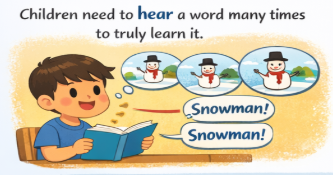
It is important to ensure that children acquire language in a context in which they feel curious, comfortable, and confident about sharing information. Some of the steps that parents need to take to create a suitable environment for language acquisition include:
– Providing ample time for children to give answers
– Praising efforts made to convey information
– Not pressuring them to provide the “right” answer
A suitable environment may also consist of additional components such as visual support, consistent routines, and clear explanation of language principles. If children learn languages under favorable conditions, the process of vocabulary expansion may become much more successful.
To conclude, language development is an important process that helps children perceive the world, interact with other people, and communicate their thoughts. It does not matter whether the discussion focuses on the development of vocabulary and comprehension skills; each of these aspects requires attention. Children can improve their vocabulary gradually but steadily. The results of communication may surprise adults because one question, “What did you do at school today?” may trigger an interesting story.
The vocabulary and comprehension supports offered by Walnut Early Supports are both meaningful and child-centric. We acknowledge that children learn languages well by comprehending them rather than memorizing them.
At Walnut Early Supports, our method is built on dividing language into smaller, more manageable pieces. Our use of visual prompts, storytelling, discussion, and real-world examples will assist children in not only comprehending words but also comprehending how and when to use them. Vocabulary that is introduced multiple times within various contexts is easier to learn and remember.
In addition, Walnut Early Supports places an emphasis on comprehension abilities like instruction following, story comprehension, responding to inquiries like “how” and “why,” and making connections between concepts. Our materials are specifically made to lessen cognitive workload, increase concentration, and promote engagement especially in neurodiverse children.
But above all else, our resources are meant to foster learning outside of our therapy sessions. Families will be equipped with practical methods that fit seamlessly into their daily life, allowing language development to occur not just during therapy but also at home, at school, and in regular conversations.