

If your child is smart, curious and full of ideas but has trouble starting homework, forgets instructions or gets really upset over changes, you’re not seeing a motivation problem. You’re looking at executive functioning skills under strain.
Executive functioning skills are the brain-based abilities that help children plan, organize, manage time, regulate emotions, and follow through. These skills are crucial for school success, not just academically, but socially and emotionally too.
This blog is for parents, educators, and therapists who want to understand executive functioning skills, including ADHD executive function challenges, without blaming or burning out. You’ll walk away with practical strategies, real life examples, and a reframed understanding: ‘Executive function is a set of skills that can be scaffolded, not a measure of character.’
Let’s break it down!
Executive functioning skills are cognitive abilities that are important for setting and completing goals successfully, which makes them the guide to actions such as problem solving or managing emotions. The brain’s frontal lobe manages executive functioning, which helps people handle different experiences in their lives.
Childhood is a critical time for developing these skills, which continue to strengthen until a person is in their 20s. Executive functioning skills greatly affect people’s daily activities. They are important in education from preschool to high school and beyond.
These skills include:
Think of executive functioning skills as the conductor of an orchestra. The instruments (reading, math, language) may be strong but without coordination, the performance falls apart.
A child may:
This isn’t defiance. It’s skill variability.
Academic success relies heavily on planning and organization skills not just intelligence.
Here’s how executive functioning skills connect to school performance:
Children may “know” the content but struggle to demonstrate it because executive demands overload their system.
For example, writing requires:
That’s a lot of executive load.
When educators interpret unfinished work as laziness, the real skill gap gets missed. Executive functioning skills determine output, not just knowledge. Supporting executive function improves participation, not just grades.
ADHD executive function challenges are often misunderstood as behavioral issues.
ADHD is fundamentally linked to differences in executive functioning skills, particularly in:
Children with ADHD often:
That gap between intention and execution is executive function in motion.
Instead of:
Neurodiversity affirming support recognizes that executive profiles vary. The goal isn’t normalization, it’s access.
Executive functioning skills are most visible during transitions, stress, and unstructured time.
Here are common breakdowns:
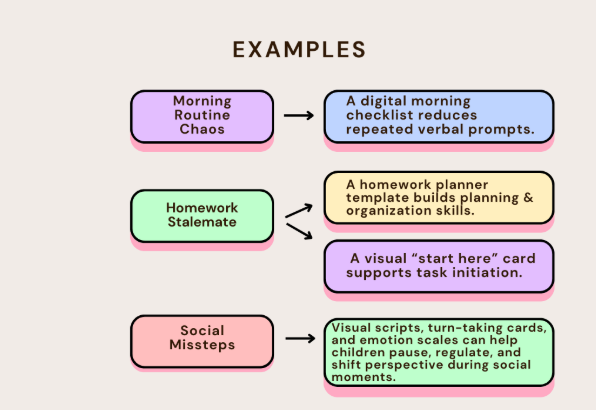
Morning Routine Chaos
The issue isn’t responsibility, it’s sequencing, time awareness, and working memory.
This often reflects task initiation difficulty, not lack of ability.
These are linked to impulse control and cognitive flexibility.
Executive challenges frequently intensify when:
Children don’t “grow out” of executive challenges without structured support. They grow into better strategies when environments are responsive.
Executive functioning skills can strengthen with consistent practice, modelling, and environmental design. Digital tools can offeroffer consistency and accessibility, especially across home and school routines.
Examples of effective scaffolds are:
Platforms such as Walnut Early Supports offer structured, therapist-informed digital materials that are designed to promote participation and real-world carryover. These types of resources help families and educators implement executive function scaffolding in a consistent, practical way across environments.
Executive functioning skills improve when supports are embedded into daily routines, not introduced only during crises. Digital libraries like Walnut Early Supports allow caregivers and educators to access ready-to-use visuals and planning tools that can be implemented immediately, supporting long-term skill development rather than short-term compliance.
The goal isn’t dependence on tools. It’s skill acquisition through scaffolding. Practical Strategies to Strengthen Executive Function at Home Executive functioning skills develo best in real-life contexts.
Instead of “remembering,” make tasks visible.
Replace: “Clean your room.” With:
Chunking reduces overwhelm.
Short and defined work periods (10–20 minutes) help build initiation and sustained attention.
Executive functioning skills are not personality traits. They are developing brain-based abilities that shape how children show up in school and life. When we reframe executive challenges as skill-based and not motivation-based, we create space for growth without pressure.
Progress may look like:
That’s real change. If you’re navigating ADHD executive function differences or supporting planning and organization skills at home, know this: structure builds confidence. Scaffolding builds independence.
Keep building the systems. Keep modelling the strategies. Growth in executive functioning skills isn’t flashy but it’s foundational.
At Walnut Early Supports, we’re here to help. And it’s worth it!